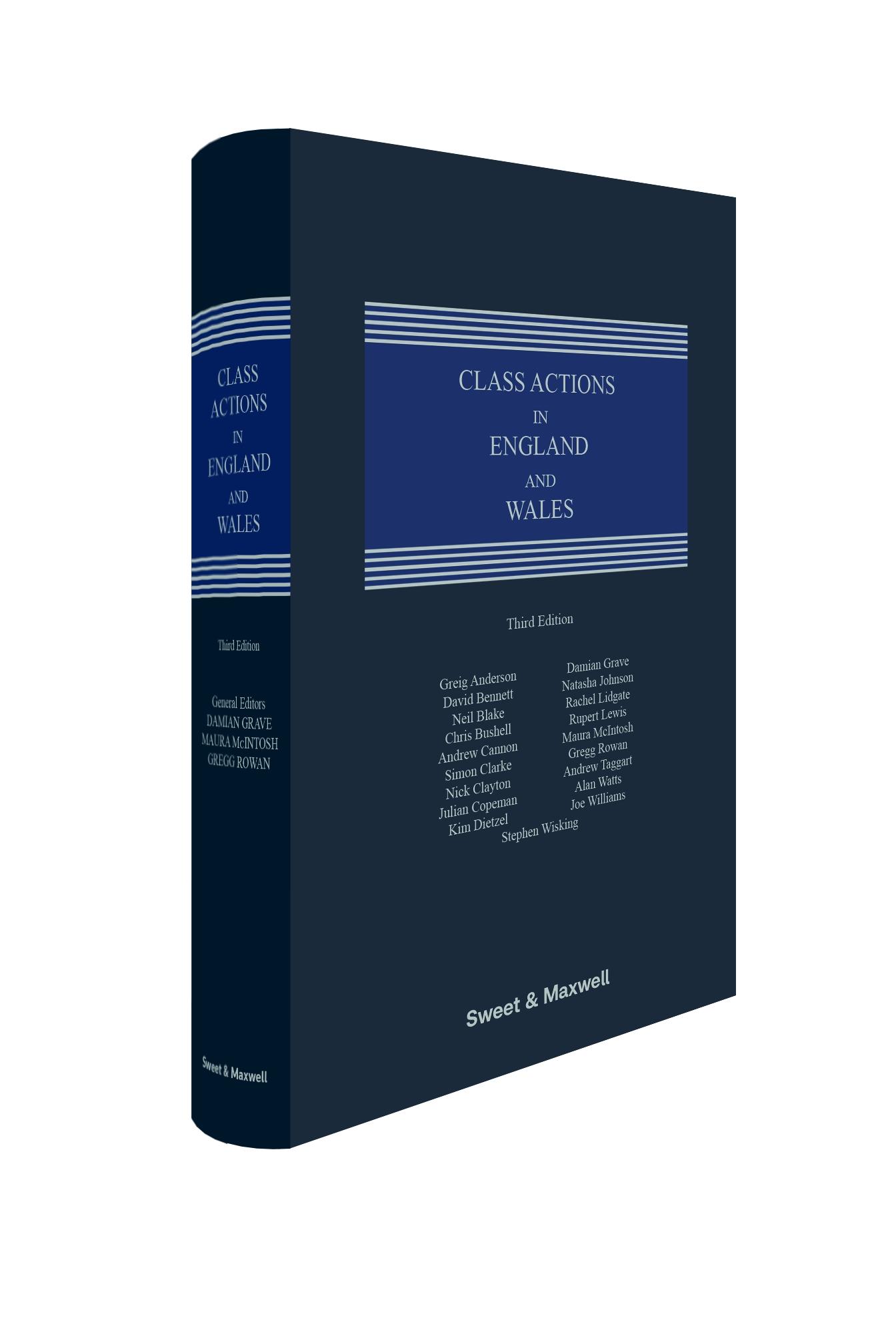
Class Actions in England and Wales provides essential reference for practitioners looking to bring or defend class action litigation in the courts of England and Wales. This is an increasingly important area of law and procedure, with growing numbers of high-value and high-profile claims being brought by large groups of claimants.
The text begins with an overview of the development of class action mechanisms in England and Wales. It then looks at when the English courts will have jurisdiction over collective claims, as well as the challenging issues of applicable law and enforcement of judgments that arise in this context. In a practical and comprehensive manner, it then takes the reader through each stage of the group litigation process, from commencement and conduct to trial and settlement, also addressing issues relating to costs and the important question of how such actions can be funded. Throughout the text, the discussion is illustrated by examples of decisions the courts have reached in practice.
Coverage draws on applicable procedural rules, legislation, case law, comparative analysis and the authors’ own experience of class action litigation.
The third edition of this seminal work:
•Updates the text throughout to reflect case law and developments since publication of the second edition, including for example the Privy Council's decision in Jardine v Oasis which abolished the so-called "shareholder rule" relating to privilege and the Court of Appeal's decision in Churchillwhich held that the courts can order parties to engage in ADR;
•Completely overhauls the chapter on competition claims to take account of the significant volume of case law in that area since publication of the second edition, including the first cases to go to trial under the competition collective proceedings regime in the Competition Appeal Tribunal;
•Adds a new chapter on the representative action procedure under CPR 19.8, which considers in detail the circumstances in which that procedure may be used following the Supreme Court's decision in Lloyd v Google and subsequent case law, as well as new chapters on tax disputes and arbitration;
•Updates the chapter on fee agreements and funding to take account of the Supreme Court's decision in Paccarand the recommendations of the Civil Justice Council in its review of litigation funding;
•Updates the disclosure section of the chapter on conducting group litigation to include sections on foreign law restrictions and confidentiality ring orders;
•Updates the text throughout to reflect the increased prevalence of cases brought using bespoke case management, without a formal group litigation order, and the factors that affect the court's decision as to the appropriate approach.